L.A. Metro breaks ground on Vermont BRT Project
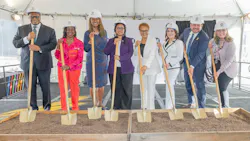
The Los Angeles County Metropolitan Transportation Authority (L.A. Metro) has broken ground on the 12.4-mile Vermont Transit Corridor Bus Rapid Transit (Vermont BRT) Project.
“This is more than a bus route. As a former community organizer in South LA, I know personally that this project is a transformational investment that will deliver reliable and affordable transportation for more than 38,000 hardworking people who use this bus every weekday,” said L.A. Metro Board Chair and Los Angeles Mayor Karen Bass. “By connecting South LA with Los Feliz, we’re creating good-paying union jobs, building a greener, more sustainable city and connecting people to local businesses, healthcare, world-class institutions and real economic opportunity.”
L.A. Metro notes the corridor serves as a critical regional link, directly connecting passengers to four rail lines—the B, C, D and E lines—and more than 13 east-west bus routes. According to the agency, more than 21% of current Vermont Avenue riders rely on L.A. Metro’s GoPass program, which provides free transit to K-12 and community college students.
On Sept. 1, the Federal Transit Administration awarded the project $149.9 million through its Capital Investment Grant. Combined with state funds and local voter-approved Measure M sales tax revenue, the project is now fully funded.
“Every day, tens of thousands of Angelenos ride the bus on Vermont to get where they need to go, from work and school to cultural institutions to medical appointments,” said L.A. Metro Board Member and Los Angeles County Supervisor Holly Mitchell. “Today, we are delivering those riders the transit experience they deserve—fast, reliable service with welcoming, comfortable stops. When riders can count on the bus coming on time and getting them where they need to go faster, they get time back to spend as they want instead of sitting in traffic or waiting for the next bus.”
L.A. Metro notes the project introduces dedicated side-running bus lanes, transit signal priority, off-board fare payment and all-door boarding, with the goal to slash end-to-end travel times by up to 24% and boost on-time performance along the corridor.
“This project improvement represents promises kept when the Vermont line and the last red car were retired,” said L.A. Metro Board Director Jacquelyn Dupont-Walker. “For decades, our riders on Vermont Avenue have navigated crowded buses and congested streets to get to work, school and healthcare. Today, we are delivering real solutions that honor their time and dignity. With shaded shelters, safer crosswalks, protected bike lanes and dedicated bus lanes, this project elevates the everyday transit experience into something faster, safer and truly world-class for everyone who travels Vermont Avenue.”
The agency says the project redefines the streetscape across the 26 enhanced stations. Upgrades include brand-new weather and shade shelters, upgraded lighting, real-time arrival displays, emergency call buttons and ADA-compliant curb ramps. To improve pedestrian safety and first/last mile neighborhood access, L.A. Metro is installing traffic-calming bus bulb-outs to shorten street-crossing distances, along with wider sidewalks and protected bike lanes.
“Carrying 11 million riders every year, Vermont Avenue is a vital lifeline for students, workers, parents and seniors across the region,” said L.A. Metro CEO Stephanie Wiggins. “We approached this project with urgency and listened closely to the community, making critical adjustments as we are cutting travel times, fortifying our bus network and building a world-class transit system ready to move LA.”
About the Author
 Brandon Lewis
Associate Editor
Brandon Lewis is a recent graduate of Kent State University with a bachelor’s degree in journalism. Lewis is a former freelance editorial assistant at Vehicle Service Pros in Endeavor Business Media’s Vehicle Repair Group. Lewis brings his knowledge of web managing, copyediting and SEO practices to Mass Transit magazine as an associate editor. He is also a co-host of the Infrastructure Technology Podcast.