Infrastructure Technology Podcast: How VR and AI are reshaping construction
Key takeaways
- New team members: The podcast introduces two new members to the team this week in Jessica Parks, associate editor for Roads and Bridges, and Noah Kolenda, associate editor for Mass Transit.
- Heavy rail leads post-pandemic transit recovery: Noah shares data from the American Public Transportation Association on transit-agency ridership recovery. The data shows heavy rail ridership rose 14.4% year-over-year in Q2 2025, marking the strongest recovery among transit modes.
- Immersive tech reshapes infrastructure: Gavin interviews Steve Davidson of American Structurepoint, who highlights how virtual and augmented reality are improving design accuracy, stakeholder engagement and worker training.
- Ahead or Behind: To wrap the episode, Brandon hosts part two of the game Ahead or Behind, where Gavin and Jessica guess which transit agencies ranked ahead or behind King County Metro Transit in Seattle for total bus ridership in 2024.
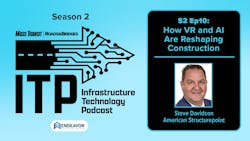
In this episode of the Infrastructure Technology Podcast, the team dives into fresh ridership data from the American Public Transportation Association, revealing that heavy rail has seen the strongest post-pandemic rebound, with a 14.4% year-over-year increase. Washington, D.C.’s Washington Metropolitan Area Transit Authority led all agencies in growth, followed by New York, Boston, Philadelphia and San Francisco. Later, Gavin Jenkins speaks with Steve Davidson, chief strategy officer at American Structurepoint, about how design-build and other alternative delivery methods are reshaping infrastructure development. Davidson explains how technologies like virtual and augmented reality are enhancing collaboration, improving project accuracy and helping both stakeholders and the public visualize infrastructure before it’s built. The episode wraps up with part two of the game Ahead or Behind and another geography lesson for Brandon.
Episode length: 52.46
About the guest
Steve Davidson is a professional engineer and the chief strategy officer from American Structurepoint. He's recognized as a leader in the alternative delivery industry. He's an expert in developing innovative design build and integrated delivery approaches to assist partners in designing and financing complex infrastructure projects.

Here is a transcript from the episode:
GJ: And welcome to the Infrastructure Technology Podcast. I am Gavin Jenkins, senior managing editor of Roads and Bridges, and with me, we have a whole new team with us. We have, of course, the man, the myth, the legend, Brandon Lewis from Mass Transit, and we are joined today by Jessica Parks of Roads and Bridges and Noah, I don't think I've ever pronounced your last name, but I'm going to give it a try right here. We're joined by Noah Kolenda from Mass Transit magazine.
NK: Nailed it.
GJ: Alright, we have our special guests, and Noah, tell us, what are we talking about today?
NK: Yes, so I thought we would kick off the first data segment of the ITP with some ridership numbers, as this year there's been a heavy focus on ridership figures as transit agencies continue to recoup ridership after the pandemic and face some financial challenges. This data is used primarily to predict revenue and adjust services and put together estimates on how the agency's ridership will ebb and flow over time and so this data set comes to us courtesy of the American Public Transportation Association and Transit app, and so I have pulled together the second quarter figures of ridership totals across transit agencies and modes for us to go over, and we're talking about Q2 data because the Q3 data won't be available to us until around mid-December, so this is what's most recently available. So to start us off, I was hoping I could get you guys to guess which mode of mass transit has experienced the biggest year over year recovery, so I'll give you some options, but I was hoping to have you guys pick out which you think has experienced the most growth, so if you're ready to start off.
GJ: I think Jessica should give out a guess.
NK: Oh, awesome. Okay, so I'll give you your options. So your transit options are heavy rail, light rail, commuter rail, trolley buses or regular bus service. So between Q2 of last year and Q2 of this year, which of those modes has experienced the largest ridership growth?
JP: I'm going to guess heavy rail just because there has been some infrastructure updates. I know in the Boston, New York area there's been some improvements to the ELA route and I think that's been going around all across the country, some of that, so that would be my guess. I don't know if that's, I'm not super confident in it, but that's what I'm going to go with.
NK: Okay, we've got Jessica with heavy rail.
GJ: And Brandon, I imagine since you work on Mass Transit, you might know the answer to this, so I'll weigh in, and I'll say heavy rail as well.
NK: Okay. Brandon, do you have a guess?
BL: Contrary to what you just said, Gavin, I don't know the answer to this. There's been a lot going on in the transit industry this year. There's been a lot of projects that have been launched or started. There's a lot going on in the bus industry, but something tells me it's not bus, but I feel like it could be close. There's a lot of light-rail projects that have just recently launched, but I'm not so sure that it would be the top, so I'm actually going to agree with you guys. I think it is heavy rail, but I think it may be closer than maybe we all think.
NK: Well you guys all saw right through my challenge and completely smashed. It is in fact heavy rail. That was the biggest year over year increase, with an increase of 14.43% of ridership from Q2 of 2024 to Q2 of 2025.
GV: Just for the Roads and Bridges audience members that are out there, what is heavy rail? What is light rail? Is light rail just like less people and heavy rail is more people or is there some sort of, give me the answers.
NK: So a kind of high level explanation is it speaks more to the layout of the rail more than the passengers themselves and how it's designed, so I may not be the best to explain this because I'm still relatively new to Mass Transit and these distinctions at large, but typically heavy rail is going to support your larger cars, larger tracks and be going typically longer distances. That's not always true, but it's less to do with passengers and more to do about the configuration of the rail itself.
GJ: Brandon, is that an accurate description?
BL: Yeah, that's basically it.
GJ: Gold star for Noah.
BL: So it is a combination of a lot of things. Passenger size has a little bit to do with it, but it's mostly about the way the rail is designed and basically about the travel length of how long a specific route could be as well.
GJ: Jessica, did you know any of that before just now?
JP: I did not know any of that. I would guess a light rail is something once you kind of said commuter rail as a separate category It did throw me off a little bit. I would've thought that was commuter rail, and I would've thought light rail was commuter rail, and I would've thought heavy rail as Amtrak, so it was kind of a total guess, but it worked out in the end.
GJ: Noah, you live in Brooklyn, New York. And are you from New York originally?
NK: I am not. I am unfortunately one of the transplants. I originally hail from Michigan.
GJ: So what part of The Glove?
NK: I come from West Michigan, so the Grand Rapids area, so I’m not used to having rail right outside my bedroom window.
GJ: Alright, and Jessica, where are you from? You're located outside Boston?
JP: I'm located outside Boston. I'm from outside of Boston.
GJ: The first time I met Jessica, I could have sworn that she was from Long Island.
JP: I went to college in Long Island.
GJ: Yeah, your accent has some flavor of New York along with the Massachusetts. It's a voice made for this podcast. We're glad to have you here. Okay, what else you got for us, Noah?
NK: Okay, so now that we've determined what mode experienced the most growth, and you guys made a lot of interesting points in talking that out because you guys were guessing. I also thought bus or light rail was going to be a larger year over year increase just because of how quickly you can deploy and adjust bus routes, and like Brandon said, how many light-rail launches there had been this year, so that wasn't really something I was very much expecting. But now knowing that heavy rail has seen the biggest increase, I was wondering if you guys could maybe rank the top five transit agencies by their increase and hint, funny enough, New York is not number one, so if you're ready, I can give you your five options and then have you rank them by who had the biggest increase.
GJ: Before you give us the options. Let's guess the options because I would like to say that I'm going to guess that Tampa is one of the options.
NK: I like that. I like where your head's at in the guessing,
GJ: Because we talked about the increase of the one station. Yeah, a couple weeks ago. Is Tampa one of the options?
NK: It unfortunately is not one of the options. You're not really going to see too much out of left field variety here. They are pretty standard in the top five, but I think the order is kind of what brings the surprise here.
GJ: Is New York not one of them?
NK: New York is one of them. It's not number one.
GJ: Oh, it's not. So New York, LA, Chicago, Houston, DC.
NK: Okay. Again, you're very close. So your five options are the Metropolitan Transportation Authority out of New York, the Southeastern Pennsylvania Transportation Authority, the San Francisco Bay Transportation District, the Massachusetts Bay Transportation Authority or the Washington Metro Area Transportation Authority. So those are your five options.
GJ: So we have to go with these long names instead of just saying the cities like normal.
NK: No, feel free to say the cities. I just wanted to get them technically correct.
GJ: Okay, so the cities then are New York City, Boston, Philadelphia, San Francisco. And then what was the other one?
NK: DC
GJ: DC. And we have to rank in order from one to five, one being the most growth.
NK: Yes.
GJ: Over the last year or five years?
NK: Over the last year. So from Q2 of last year to Q2 of this year, who saw the biggest jump?
GJ: Okay, well it's not San Francisco. I would imagine people are fleeing that city because of the prices. In droves. What's SEPTA?
BL: I'm going to say it's not SEPTA just because of the challenges that they have faced when it comes to budget and things like that. There's been a lot going on, obviously. The Southeastern Pennsylvania Transportation Authority in Philly.
GJ: See SEPTA, I would say SEPTA is number one because I mean, you have the Mare of Easttown, you got Task and HBO only filmed shows where there's an explosion in popularity and population, so I'm going to say that because of those two phenomenal HBO shows that more people have been going to Southeast Pennsylvania and Philthadelphia, excuse me, Philadelphia. I'm sorry, I'm from Pittsburgh. I'm just teasing. Teasing my Flyer fans out there, and I would say that it's the SEPTA number one.
NK: Okay. So do we all want to lock that in as our number one? Do we want to have a communal ranking?
GJ: Well, Brandon doesn't agree.
BL: I kind of feel like it may be the MBTA.
NK: Okay, so Boston's number one for you two.
GJ: Alright, give us, are we correct with number one?
NK: Unfortunately, no, you are not correct. Number one if you're ready for the answer.
GJ: Yeah.
NK: Came from Washington, D.C.
BL: That was going to be my other guess.
NK: With a 28.42% year over year increase, was one of the largest year over year increases I saw even digging back into APTA data from years past was a massive jump.
GJ: The swamp. People are like, ‘I want to live in the swamp, let me get to the swamp’, and they want to use the glorious mass transportation in the swamp in the area. They love it.
NK: Okay, so with number one out of the way and knowing it wasn't New York City, do you guys have a guess for who was number two?
JP: New York City?
BL: It would either be New York or Boston. Yeah, I would go with New York.
NK: You did have that pegged correctly. I did play up the fact that, well it wasn't first, it was still in the top three. So New York's Metropolitan Transportation Authority experienced a 15.84% year over year increase. Again, quite substantial in this area. A lot of these increases were in the single digit percent if they didn't decrease year over year, so these five were really quite performing.
GJ: Alright, give us the rest of the top five.
NK: Can do. So number three was the Massachusetts Bay Transportation Authority with a 15.5% increase year over year. Number four was the Southeastern Pennsylvania Transportation Authority with a 13.6% year over year increase, and number five, as you guys all predicted, was the San Francisco Bay Rapid Transit District, with a 10.21% year over year increase.
GJ: Well, I'm really disappointed in Southeastern Pennsylvania. I mean, you got a lot of water out there and a lot of quarries to just go swimming in. These are all very task related jokes if you haven't seen that TV show, but that's awesome. Thank you so much, Noah, for coming on and dropping some stats on us.
NK: Absolutely. And just before I go, to set this in context, the jump, the 15% year over year jump for heavy rail, that equates to almost 100 million more passenger trips than last year's Q2.
BL: Wow.
NK: So this is a big increase year over year. I know that we've been talking a lot in percentages, but I just wanted to kind of set that in context because it is a big year over year jump.
GJ: That is massive.
NK: Well, thank you all so much for having me for the introductory segment. It was fun to get my first show under the belt.
GJ: Well, we're so glad to have your valuable asset to the Mass Transit team and to the ITP team. Thank you, Noah. Now coming up, I have an interview for you guys, and it is with Steve Davidson, who is a professional engineer and the chief strategy officer from American Structure Points, and Steve is highly respected. He's recognized as a leader in the alternative delivery industry. He's been working in this aspect of the industry for over two decades. He's an expert in developing innovative design build and integrated delivery approaches to assist partners in designing and financing complex infrastructure projects. So without further ado, here is my interview with Steve Davidson.
GJ: Steve Davidson, welcome to the Infrastructure Technology Podcast. How are you doing today?
SD: I'm doing great today, Gavin. Thanks for having me. I mean technology, and it's so important to the architectural and engineering industries. It's always exciting to talk about it and discuss new ideas.
GJ: Alright. Yeah, I couldn't agree more. I live in an apartment and so I'm going to just warn you right away that there is a cleaning person down the hall using the vacuum. It doesn't appear to be showing up too much on my end with the audio levels, but my dog Bob might start barking at any minute so just warning you now, Steve, that that might happen.
SD: I want to meet Bob. Bob should be part of the podcast.
GJ: Oh, he's hiding under the desk. He's afraid of the vacuum down the hall. He's a scaredy cat. Alright Steve.
SD: Well, if it makes a difference, I can't hear the vacuum.
GJ: Okay, great. Well you can't, but the audience might. You never know. Alright, let's dive into this. Let's talk some technology, but first let's start off with design build as an alternative and increasingly prominent project delivery method. While the majority of our audience will be familiar with this method, give us an overview of how design builds have gained prominence in the roads and bridges construction industry in recent years.
SD: Well, alternative delivery, which design build is part of that, has been growing as a delivery model across the roads and bridges industry. Right now there are over 48 states that are utilizing design build and alternative delivery and as part of their overall project delivery system, so it's growing more and more every year. Right now, over 18% of highway and bridge construction is done via design build and it's growing every year, so it's a very popular delivery model because in general it provides for a faster delivery, it drives innovation and clients are seeing cost and innovation benefits from the delivery model. So if you look at design build or alternative delivery, you have design build, you have CMGC and now you're getting into more things like progressive design build where you're getting earlier contractor involvement and design involvement in this process that are really helping drive innovation and projects in a multitude of states.
GJ: Alright, so American structure point has been, well, it is seen firsthand how technology trends that are transforming the industry, how those go into effect and how design build projects are conceptualized, executed, managed. Give me some examples of those like building information, modeling, BIM and virtual reality and tell me how those are influencing projects.
SD: Absolutely, so BIM is really, a lot of times BIM is used on the vertical side, so in the building and architectural industry, and we use it as part of our overall design process. One, because it provides for an ability to view the project three dimensionally and once you start looking at things in a three dimensional way, you can more easily see where there's conflicts. So let's say you have a building and you're looking at it, and you have your structural beam elements, and you have mechanical piping, and you might not see that in a 2D view. You start putting it into the BIM model, and you start looking at that in a 3D environment, you can more easily see where there's clash detection or conflict between those design elements, and you can rectify those at a much earlier level rather than which nobody wants is having to rectify that out in the field when they're building the project, so it allows for much earlier detection of conflicts, whether that be from a design perspective or even from elements that are already existing. One of the things we see with the 3D modeling on the horizontal infrastructure using open roads and things like that is you can see when you put in the survey data from, whether it be existing utilities, proposed future utilities, anything along those lines, you can start seeing where those might conflict with light poles, signal poles, bridge, foundations, so once you start seeing those conflicts, you can either design to avoid them or have early conversations with stakeholders to move those elements so that they do not become an impediment to construction. Because anytime there's issues out in the field, you end up having delays in schedule cost implications and nobody wants those when they want their projects done expeditiously. And looking at kind of wrapping back in design build that really helps with that can often help with that early coordination in those delivery models because you're working through that early design phase with the utility companies, with those other stakeholders to identify and mitigate those potential, those conflicts to kind of take the next step and look at what you're talking about, virtual reality and augmented reality. We use augmented reality and virtual reality as part of our design process, so once you start looking at things from a virtual perspective, you can take that 3D model, and you can add a background to it. You can add different elements to show stakeholders what that will look like. Here's what the inside of your building looks like. You can show someone physically walking around, Hey, here's what the escalator looks like in this position. You could start really seeing and walk through each element as if you were in it, as if from your own eyes if you're walking through that model, so virtual reality and augmented reality are really becoming at the forefront of part of our design processes, certainly on the vertical world and even now beginning to use that more and more on the horizontal world because it's important to be able to show the traveling public, here's what this new interchange will look like once you add in the real life traffic, what the traffic will be like in 2030 or 2050. Here's what the traffic will look like and how that interchange or that roadway system will operate and really give a viewpoint from the driver of exactly what it will look like driving through before you've ever put any concrete or steel in the ground, so it's very, very powerful tool for owners to see what their end product may look like well before they're really even awarded a construction contract, so it's a very, very powerful tool, and it allows you to influence and talk through with stakeholders. I keep coming back to that term stakeholders so that could be the traveling public, it could be local businesses or anybody impacted by that project. It gives you an opportunity to show them exactly what that project will look like and how it will impact their community, and it's a really powerful tool when you're designing elements in this built world that we're living in now. People want to see what things look like well before construction has started, so they can be excited. You can really get stakeholders and the public excited about what's coming to their community, the improvements that are happening, so as you're talking about spending tax dollars or a private company spending dollars on building a new facility, it really allows them to showcase to the public how they're going to impact their community from a positive environment, and it's possible to see those pictures.
GJ: But what about for construction workers? Where does VR and AR come in there? Two years ago, I remember people in the industry saying that VR and AR were going to be much more prominent by now than they are, and I think a lot of people talked about maybe it helping train people and since we have this labor crisis, and a lot of people who are project managers always talk about how they're lacking in employees who are trained properly. And is there a way that VR and AR can help bring a new class, a new generation of workers up to speed faster?
SD: Absolutely. So you look at the big equipment manufacturers, that's probably the easiest place to look at. So you look at John Deere and Caterpillar and all these large heavy equipment makers, they have set up virtual reality simulators and things like that to train workers at an early stage rather than send them out on, used to be you might go to trade school, you'd learn how to drive a piece of equipment and then get hired on. Now they're allowing people to do all that within a simulator environment. Just no different really than the aviation industry uses simulators for training and development. It's a lot easier to train someone in a simulator in that virtual environment than it is having them go out and run a big diesel bulldozer out on site, so it really allows that training scenario, and just like in an aviation simulation, you can really have that exposure to a lot of different environments. It could be really hard to train people on a piece of equipment really in tight confines or next to something that could be, I don't want to say unsafe, but an environment that's very more risky, and this can provide for scenarios where you're having people train on equipment next to live traffic or anything along those lines without the safety implications of having them actually be out in the field to train that, so you can do different scenarios that way. So we're seeing that more and more involved from a workforce development, and it's exciting because the younger generations are certainly used to that from a gaming environment and things like that, So it's very much akin to that. They're getting to train on simulators that really are lifelike. It's amazing to see how that has changed even over the last couple of years from just from a training and workforce development. You're right on that Gavin in the fact that that is an important aspect. The other thing we're seeing is the implementation of our 3D modeling right into machine grading. We're talking in multiple states, they're going to zero, basically no plans, no paper plans. It's all electronic delivery of plans that go right into the construction that can be put right into the construction equipment from a grading perspective, from a paving perspective, which ultimately saves time and money. Now, there are discussion points with electronic delivery as far as liability. There are discussions with that that are still ongoing, but it is the way of the future, and it will streamline the delivery process from design delivery to construction delivery.
GJ: Okay, let's take a sidestep here away from technology and talk about legislation, so you've completed legislative reviews for alternative delivery, enabling legislation from multiple states. Tell me about that, and why this legislation is important to have.
SD: Well, every state you want, as an engineer, I've been doing this for 28 years and looking at what's good for the industry and really what's good for the public and the public, whether that be and public agencies should have and want to have every tool in the toolbox to deliver projects effectively and efficiently, and really, you never know what you might need, so I've been an advocate for alternative delivery with states for many, many years. So doing legislative reviews. If a state doesn't have the ability, not every tool in the toolbox, we want to help and as an industry provide those, provide that guidance and feedback. So back when Indiana was first looking at P3 Legislation, helped them review their legislation and actually testified in support of their public private partnership legislation because that's an important tool. Ultimately, that was important for the delivery of the Ohio River Bridges project down in southern Indiana between Indiana and Kentucky for the big infrastructure project because that project might not have ever been able to be delivered under conventional means and methods so helping states that they don't know what they don't know. And so being an expert and being really providing that feedback and guidance, happy to do that for different states. More recently, we've helped states who have enacted design build legislation help them develop their programs. So as an example, the Nebraska Department of Transportation, they wanted to use Progressive design build and CMGC to help deliver some of their programs. We helped them deliver and develop documents. They're basically contract documents so that they could more efficiently deliver alternative delivery projects so now they've awarded their first CMGC project underneath those documents, so really helping on the legislative side and then ultimately on the document delivery side, so they can get their program up and running, and it's been great. It's great to work with open-minded clients across the country who really want to take their program to the next level and are willing to.
GJ: Are you calling politicians? I mean, you're working with legislative reviews?
SD: Well, everybody. It does take open-minded people and politicians to see that there are other ways, and like I said, design build and alternative delivery are not the way to deliver every project tried and true methods of design bid build are always going to be around because there are certain projects that lend themselves to that, but when an owner or a client is faced with having to do things quickly, and they don't have time to deliver it, if there are specific risks that maybe make more sense for get a contractor involved early to help mitigate risks, those are great projects to look at from an alternative delivery perspective.
GJ: Okay. Alright, let's talk about the future. Are there any other trends that you can see shaping up and can you look into your magic eight ball and tell us what will help the transformation of design building along in 2026?
SD: I think it really comes to the balance of risk. So every contract or every job, there's the balance of risk, and you look at, an owner wants to dump all this risk onto contractors, and contractors want to push back contractually and have the owner hold that risk, so I look at it from both lenses and go, if both people, if both parties walk away a little bit upset, that's probably the best balance of risk mitigation, but at the end of the day, if we can put risk and that risk is held by the appropriate party, whether that be an owner or the contractor, that's going to drive down costs on projects, so as I look at things, we're going to continue to do more and more alternative delivery. We see it across the horizontal side, both roads and bridges. We see it on the utility side, and we see it on the vertical side. More and more owners turn to alternative delivery to deliver projects, so there's no doubt that area of delivery is going to grow and it's really, it ultimately comes down to a balance of risk. It comes down to being open-minded both on the contractor side and owner side to be open to negotiation on risk mitigation and that has to start early. Every project that we work on, we do a risk mitigation matrix, whether it be a design bid build job, or a design build job. We do that. That's part of our design processes at American Structure Point to do that because it's important because there are parallels that can be drawn from design bid build projects and design build projects, and that expertise is great to have on both sides of the ledger, and you can bring that experience and there's benefits to be had. If we can mitigate risks on a design bid build job, that's better for an owner. If we can mitigate risks on a design build job and help an owner drive down costs through working with a contractor, that's really good because at the end of the day, we're on a lot of the projects. We're trying to be good stewards of the public's money. I mean, at the end of the day, a lot of infrastructure projects are paid for by, Gavin, your tax dollars, my tax dollars. We want to be good stewards of that because every dollar we can save is another intersection we can improve or another safety improvement we can do to help to make a road more safe, to deliver cleaner water to somebody. That's important to me as an engineer that we ultimately have that goal in mind to be good stewards of taxpayer money. I think that's very, very important, and every dollar saved is another project or another safety improvement that can be done to really make people's lives, the public lives, better.
GJ: That's awesome. I mean, for taxpayers, I don't pay taxes. I funnel all of my money into a Shell corporation that's in the Caymans. It's good for the normal people to pay your taxes.
SJ: I hope none of the politicians listen to this podcast or hear about your offshore accounts, or the IRS may be looking for you.
GJ: Well, they're people, so they'll understand. They can be. I'm just being smart. Steve, Thank you so much for your time and for putting up with my stupid jokes, and I thank you. It has been great interviewing you. Our listeners won't be able to see this, but it looks like you have a beautiful corner office, and it looks like a beautiful day in Indianapolis.
SD: It is. I mean, it is sunny today. Normally starting about this time of year. It becomes gray and boring for about six months in Indiana, so it has a beautiful fall day in October.
GJ: And are you going to be heading to any trade shows in the near future? You're going to be at conexpo?
SD: I won't be at conexpo, but I will be at the Design Build Institute of America DBIA at their national conference in Las Vegas in, I think it's in two weeks, so I'll be out there. I am actually the DBIA Great Lakes District President, so I'll be out there, so yeah, so that's probably the biggest thing I have going on from a trade show perspective.
GJ: Alright. Well, all of our listeners, if you're going out to that show, be sure to find Steve and shake his hand. Thank you again, Steve. Hope to have you back on soon.
SD: Anytime.
GJ: And welcome back. That was my interview with Structure Points Steve Davidson. Well Brandon, give it to me straight. What did you think?
BL: I mean, Steve did an excellent job at breaking down the technology behind this, and I've never been the biggest fan of virtual reality, but this technology that's going to be developed where people can see what a road or what's going on with the concrete and everything is what it's going to look like before they're even on it is amazing, And I think it's going to save so many people's lives.
GJ: It's incredible the technology that's being developed for the roads and bridges industry today. Jessica, what did you think?
JP: I thought going off of that, what you said, Brandon, I thought that was really interesting in the way that it can kind of get the community excited around a project. It's because they can see it before it eventually comes. I thought that was a really interesting thought that I hadn't really thought of before is just the community aspect of what their taxpayer money is going to and just seeing it ahead of time.
GJ: Yeah, absolutely, and Steve is such a great guy and well-respected throughout the industry. It was a pleasure talking to him and so glad to have him on. There's no smooth transition into a game, but we are now going to be playing a little bit of a game to wrap up this episode. Brandon, what are we doing?
BL: So as promised, a couple weeks ago, we played the game known as Ahead or Behind where I told you guys where I took the top 20 bus ridership statistics from 2024 the entire year. And King County Metro Transit was ranked as number 10, and on the ITP, we guess whether another agency was ahead or behind that ridership data. We did not go through that entire data set. We went through about three or four of them, so I have more for you guys to guess and figure out whether this agency was ahead or behind King County Metro Transit. Are you ready to play part two of Ahead or Behind?
GJ: Yeah, let's do it, and it's King County, right? Where is King County again?
BL: King County Metro Transit. It is in the Seattle, Washington area.
GJ: Okay. All right.
BL: And as a quick reminder, in 2024, that agency had approximately 87 million riders for the year of 2024. So the first question, the Regional Transportation Commission, or the RTC of Southern Nevada, did they have more or less riders in 2024 than King County Metro Transit?
GJ: I'm going to say less. We go to Vegas quite a bit for our jobs. We go there for World of Concrete. We're going to be there for Expo this year as well. Both of those shows coming up in early 2026, and I don't see that many buses. I see a lot of taxis. I see a lot of Ubers. I see a lot of Lyfts. I don't see that many buses, so I'm going to say less than. What do you think, Jessica?
JP: I'm going to agree with you on that one. I can't imagine too many buses going through Vegas. I just don't see it.
GJ: Have you been to Vegas?
JP: I haven't, but just from my under understanding of it, I don't see it as too glam.
GJ: From the Ocean's 11 movies. You've seen all the Ocean's movies, and there were no buses.
JP: I just don't see it being very glamorous driving down the Las Vegas trip in a bus. I think that people would rather be in a taxi.
BL: Well, I have also never been to Vegas, but it is on my bucket list to go to that city one day, but you guys are both correct.
GJ: Why is it on your bucket list? It is an awful city.
BL: See, I think Vegas in the next 10 years is going to explode.
GJ: Explode. Let's explode. Explode how?
BL: I think it's going to be one of the most popular, I'm not saying it's in the top, but I just think people are going to migrate there.
GJ: Well, they already have. It actually has a problem. It was in the news recently that it has taken a huge hit in its tourism people. There's casinos everywhere now, so people aren't going there to gamble, and they have all the major sports teams now. They got, just recently, the Oakland A’s moved there, which is just insane to me. They have the Raiders for some reason. They have a hockey team. It's like a normal major city instead of being this gambling mecca in the desert, and I don't think that we should have major cities in the middle of the desert. That's just me. Call me unreasonable.
BL: No, there's definitely, there's just something about Vegas that's always appealed to me. Maybe it's me being from cold weather Ohio, and Vegas always looks so beautiful.
GJ: See, that's the thing. It’s not. Come there in January for World of Concrete, it is like 45, 50 degrees and gray.
BL: Right, and then in August its like 130 degrees. Whenever you see Vegas, they must always just take shots of it in the summer. It always looks like it's 100 degrees.
GJ: 100 degrees easy. It's like 100 degrees in the shade. In the sun, its 120. It's like being on Mars. It's insane. I think that there's a lot of great restaurants in Vegas. It's great hospitality and wonderful people there.
BL: I think it's just an experience. I think everybody should go there at least once. Whether you like it or not, I think it's something that it offers that the rest of the states in the U.S. don't offer.
GJ: My hot take is that we shouldn't have cities in the desert, any of the cities. The cities shouldn't be built on sands. This is my hot take. It's fair.
JP: I agree.
GJ: What’s our next city?
BL: So now that Noah has warmed us up to all of this data with that excellent introduction segment, I think we're all thinking about this data segment pretty clearly, but this next one is interesting because it's in the same geographical region, if you will, a little bit of Seattle. Let’s talk about Portland, Oregon’s Trimet. Again, same part, sort of western part of the United States. Did they have more or less bus riders in 2024 than the King County Metro Transit?
GJ: Do we have statistics on how many of these bus riders were wearing costumes or were naked because that is what I'm seeing out of Portland. Just people dressed up in costumes or riding bicycles naked. That's all I see whenever I hear about Portland, but I'm going to go less just because Portland's a smaller city than Seattle.
JP: I was going to go over just because it just seems like the culture in Portland, it just leans towards riding buses, and I know that there's an increasing population there of, it doesn't seem like people have cars, so I would imagine there's people riding the buses, so that was my guess.
BL: Well, Gavin is correct.
GJ: Okay.
JP: Nice.
BL: It's actually significant, believe it or not. So in 2024, a reminder, King County Metro Transit had about 87 million annual riders. TriMet only had about 42 million.
GJ: Okay. Alright, yeah, that makes sense.
BL: So the difference there is significant. If you guys want to know, Trimet was 16th on the list.
GJ: Okay.
BL: Okay, number three. We talked about this agency a little bit earlier with Noah. Gavin, I know you hate the full name of this agency, the Southeastern Pennsylvania Transportation Authority.
GJ: Yeah, SEPTA.
BL: SEPTA. So did they have more or less bus riders in 2024 than King County Metro?
GJ: I'm going more. I think that, like I said, Philadelphia first off. I jokingly called it Philthadelphia. That was a reference to something that people here in Pittsburgh say. It was a joke. I'm a huge fan of Philadelphia. I love the show It's Always Sunny in Philadelphia. Probably one of my favorite TV shows. I think that Philadelphia has a rich, rich culture, and it's a beautiful city, and I think a lot of people have been flocking there and a lot of those people like to use public transportation, so I'm going to say more.
JP: I'm going to go with more as well. I understand that the subway in Philadelphia is not very sufficient, so I would imagine that that makes people lean towards buses, more so I would say more.
BL: You guys are correct. They had about 115 million bus riders last year.
GJ: Wow. That is great. Yeah, Philadelphia, I get it. Yeah, I mean Philadelphia has a lot of suburban area and so a lot of them are using buses as well. Before we wrap up, I just want to say that last week I was at the Bentley Conference, the Bentley Yearend Infrastructure Going Digital Awards. It's an annual conference, and it is one of the best shows around. We've had Bentley people on the show before. Mark Pittman, Ian Roseum, and Bentley does it right, and it's always outside of the United States because Bentley is a global company and has software that goes to infrastructure projects all over the globe, and this year, we were in Amsterdam, which is in the Netherlands, and what a beautiful city. I had the honor, just the joy of taking a couple days off, and I rode a bicycle around Amsterdam. Brandon, I know you're not a big fan. We've talked about this many times. You're not a big fan of the cyclists, and this is why I'm bringing it up. Amsterdam does it right. They have specific lanes, and it's not just like here in America where you have a little bit of a green lane and then it just ends and so they weave out their bike lanes. They don't have parked cars. They don't just randomly stop. Sometimes in some places they have little concrete dividers separating the bike lane from the sidewalk, so it's like, here are the two lanes on the road. Here's the bike lane and then here's the sidewalk, and it works. People in Amsterdam don't even wear helmets. I was riding around a bicycle for days. I didn't see a single helmet on kids, not on adults, not on myself. I just rented a bicycle and just went. It was awesome.
BL: Now, before I comment on that, let's clarify that, I get with my geography skills that Amsterdam is a city. I'm going to clarify for everybody here that everybody is aware that I am now aware that Amsterdam Is a city.
GJ: Okay, Amsterdam is a city. It is in the country of the Netherlands. Geography. Quiz for you, Brandon. What countries border the Netherlands.
BL: Countries. Germany?
JP: I think it does.
GJ: That it does. Yes, that is correct.
BL: Oh my God, I got it right.
GJ: You redeem yourself. It has one more. Germany has a big border with it, actually. Yeah.
BL: Okay. Poland.
GJ: No, Poland's on the other side of Germany.
BL: Okay.
GJ: Starts with a B.
BL: Berlin.
GJ: No, Berlin's sitting in Germany.
BL: There I go again.
GJ: It's a country that starts with the letter B. You can do it. Think chocolate.
BL: Chocolate. Okay.
GJ: French fries. Think waffles.
BL: Think waffles. Belgium.
GJ: There you go.
BL: The waffles is what got me. I did not think of Belgium chocolate. I know Halloween just passed. Guys, I'm not a candy eater.
GJ: So you're not a candy eater?
BL: No, I will eat one Reese's peanut butter cup if it's left in the bag. After I give out all the candy. I am the person that will sit on my front porch and talk to my neighbors. The one time of year I talk to my neighbors is on Halloween.
GJ: Okay, well thank you for playing geography. We should just make this a running bit. This might be a running bit that we bring in.
BL: This is our first ever bit.
GJ: Yeah. What we will do is just, it has nothing to do with Mass Transit or Roads and Bridges, but we are just Brandon, we're going to improve your geography if it kills us and from now on at the end of every show, we are going to do a little bit of geography with you, so we can build you up. I love Amsterdam. This is my second time here or there. I went there in college on a European backpacking trip. I love that part of Europe where it's Belgium, Germany, the Netherlands, just beautiful, beautiful places.
BL: Well, if you guys have any thoughts on the great city of Amsterdam or how they handle their bike lanes, make sure you email us at [email protected].
GJ: And email us and tell us what you think about anything. Tell us what you think about the interview with Steve Davidson. Tell us what you think about Noah and Noah’s stats. Give us a shoutout, and we want to thank Jessica Parks for joining us today for Jessica's first episode of the ITP. We want to thank Endeavor B2B, our parent company, and we want to thank you the listener for joining us. And we will be back next Tuesday with another episode of the Infrastructure Technology Podcast. I'm Gavin Jenkins.
BL: I'm Brandon Lewis.
JP: I'm Jessica Parks. Thank you guys for having me. It's been a pleasure.
GJ: Alright, we'll see you next week. Goodbye.
About the Author

Brandon Lewis
Associate Editor
Brandon Lewis is a recent graduate of Kent State University with a bachelor’s degree in journalism. Lewis is a former freelance editorial assistant at Vehicle Service Pros in Endeavor Business Media’s Vehicle Repair Group. Lewis brings his knowledge of web managing, copyediting and SEO practices to Mass Transit Magazine as an associate editor. He is also a co-host of the Infrastructure Technology Podcast.