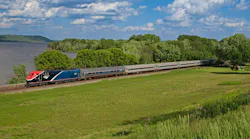
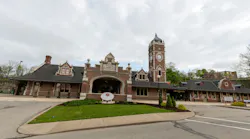
WI: Amtrak in 'best position ... ever' to bring passenger rail back to Madison
It’s been more than 50 years since passenger trains regularly served Madison. For nearly as long, the city has been trying to bring them back, only to see its hopes dashed many times.
Amtrak expects this time to be different.
Excitement around the extension of rail service to Madison has mounted over the past year. Last November, Madison picked Wilson Street as the city’s preferred station location. In March, Amtrak announced plans to bring twice-daily service to Madison by 2030. In June, the state approved the sale of the State Office Building at 1 W. Wilson St. to a developer who plans to convert its lower floors to an Amtrak station.
In October, the Federal Railroad Administration announced it would award the Wisconsin Department of Transportation more than $218 million for final design and construction of Amtrak’s proposed Hiawatha West route, which would extend the Chicago-to-Milwaukee Hiawatha service to Pewaukee, Watertown and Madison. The grant requires the state to pay 20% of the project cost, or up to roughly $54.5 million, some of which may come from local governments along the route.
And this month, Wisconsin Democrats have taken control of state government for the first time in 16 years.
Gov.-elect David Crowley has said he would accept the grant. The Amtrak route extension “is exactly the kind of investment that moves people, creates jobs, and builds a stronger state,” he wrote in a post on X in March.
Crowley’s opponent, Republican U.S. Rep. Tom Tiffany, had said he opposed using state taxpayer dollars to build the line or to pay a $2.5 million annual operating subsidy.
Arun Rao, senior director of state partnerships and development at Amtrak, declined to comment on how the election outcome could affect the state’s willingness to put up its share of the funding. He said only that Amtrak has consistently seen “tremendous, broad support” from the communities along the Hiawatha West route.
But Rao said the Consolidated Rail Infrastructure and Safety Improvements grant announced last month shows how much potential there is for passenger rail in the Madison area.
Nationally, he said, Amtrak is seeing its highest-ever demand, even in communities much smaller than Madison. With rapid population growth, UW-Madison, the state Capitol and strong technology and biotech sectors, Dane County is “a slam-dunk kind of market for intercity passenger rail,” he said.
Along the Hiawatha West route, Amtrak also found enthusiastic local leaders, a willing host in the Wisconsin & Southern Railroad and a route that is feasible to plan and won’t require much land acquisition.
“This is the best position we’ve been in to get this done, ever,” he said.
What makes this time different
This is not Wisconsin’s first time being offered a major federal investment in passenger rail service to Madison. The state was in line for $810 million in federal stimulus money in 2010 for a high-speed rail connection to Milwaukee under then-Gov. Jim Doyle, a Democrat.
Then, like now, Madison’s leaders envisioned a station along Wilson Street.
But in 2011, Doyle’s successor, Republican Gov. Scott Walker, rejected the money, dooming the project. Walker wrote in a Facebook post last year that the line was still a “dumb idea” and he “was right to kill this idea years ago.”
Liz Callin, Madison’s principal transportation planner, said the city worked with the DOT, Amtrak, the railroads and other local governments on a plan to expand service in Wisconsin in phases, rather than trying to do it all at once.
The proposed Hiawatha West route is relatively simple from an engineering perspective, she said: Amtrak will be “extending two trains a day of an already very successful intercity service” to a market that “really, really wants service.”
In the future, Amtrak aims to upgrade the tracks between Madison and Watertown to increase train speeds, though not to the levels of high-speed rail, Rao said.
There’s also interest in adding service to Eau Claire and Minnesota’s Twin Cities and potentially putting a second station in a more suburban part of Dane County.
Madison already has money set aside
Rao didn’t say when service could start in Madison, but he said Amtrak expects approval of the service development plan for the route by early next year and can then proceed with preliminary engineering and environmental review. After that, he said, if all the funding is lined up, Amtrak will be able to move straight into final design and construction.
The DOT is requesting $52 million for Hiawatha West in the 2027–29 state budget. The total cost of the service extension is estimated at $272.5 million.
Madison’s 2027 capital budget, adopted last week, includes $3.5 million for passenger rail funding. It wasn’t a new request this year, Callin said. The city set the money aside a couple of years ago to buy a site for a station and moved that money from the Economic Development Division to the Transportation Department in the 2027 budget.
The federal grant is a big step forward, she said. “I don’t think we can overstate how important that federal investment is to the project.”
How long the route takes to design and build — and whether the State Office Building redevelopment comes together as planned — will determine where the first trains stop in Madison.
Amtrak may use a city-owned parking lot at 499 E. Wilson St. as a temporary station, Callin said.
If the location of a permanent station has been finalized by the time the route is built but the station isn’t finished in time, a temporary station may be sited closer to the permanent station, she said. It’s also possible that the permanent station will be ready and a temporary station won’t be needed at all.
© 2026 The Wisconsin State Journal (Madison, Wis.).
Visit www.wisconsinstatejournal.com.
Distributed by Tribune Content Agency, LLC.